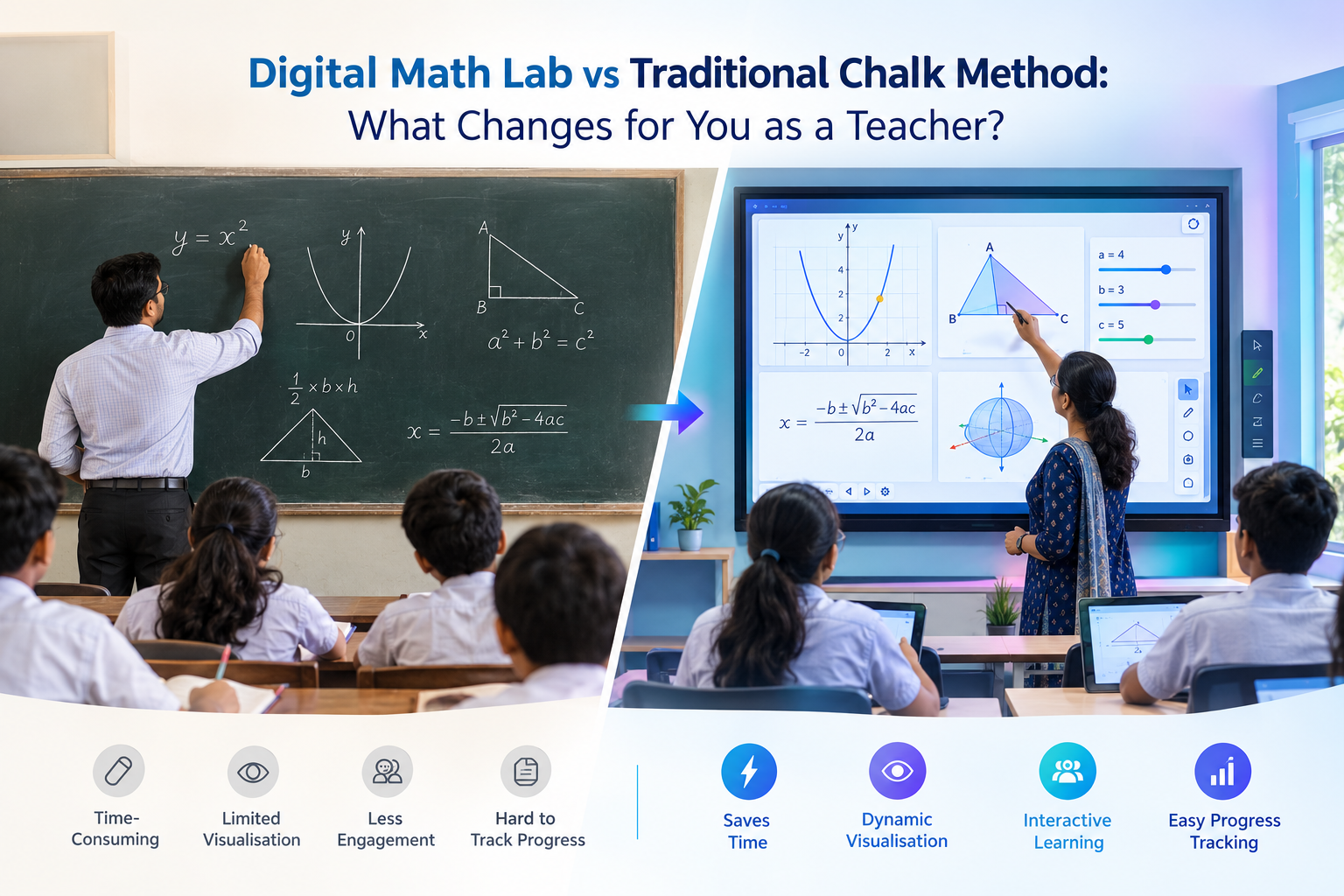
Choosing the Digital MathLab for your school directly influences how students comprehend and apply mathematical concepts. A well-designed math platform offers students an experience beyond routine textbook exercises by giving them opportunities to engage in activities and explore concepts with innovative visual resources, digital tools, and practical problem-solving.
In this blog, we explore the key features to consider when choosing the right math platform for your school.
What Makes a Math Lab Effective for Mathematics Learning?
Digital MathLab is designed to help students grasp mathematical concepts through exploration and activities rather than simply listening to explanations or lectures. This practical application involves simulations and visual representations that let students see and understand how maths works without information overload. Activities of this sort are more likely to keep students engaged, motivating them to explore and learn concepts while helping them connect math concepts with what they are taught at school.
Effective Digital MathLab Activities should complement the school’s curriculum rather than being seen as an external form of learning outside the classroom. Educators can use interactive exercises to demonstrate concepts, reinforce what’s being taught at school or provide more practice. Therefore, the effectiveness of MathLab lies in how well it supports foundational knowledge, conceptual understanding, student engagement, and supplemental learning in mathematics.
7 Must-Have Features in a School Digital Maths Platform
Educators must move beyond basic considerations when they are evaluating a school Maths platform. The following features can help schools assess whether a platform is suitable for their students and teachers:
- Interactive and engaging learning activities – All activities must motivate students to explore concepts and encourage active participation rather than simply memorizing information.
- Curriculum-aligned mathematics content – The lessons and exercises must be closely aligned with the school’s curriculum and learning objectives.
- Age-appropriate learning resources – Content for Grades 6-10 must be appropriate in terms of difficulty, language, and visual presentation.
- Interactive Visual Teaching Tools – Simulations, visualisations, and interactive exercises can make maths more engaging and easier to understand.
- Progress tracking and assessment – Most importantly, teachers should have a clear idea of student performance. They should be able to monitor performance and identify areas where students require further support.
- Teacher-friendly management features – Integrating technology into teaching can be simplified through simple assignments, monitoring, and classroom-management functions.
- Device compatibility and accessibility – The platform should seamlessly work across various devices, including computers, tablets, projectors, etc., making it easy for teachers to use the platform in different classroom settings.
How Digital Math Lab Technology Supports Interactive Math Education
Digital MathLab technology can make mathematics more interactive by allowing students to explore concepts, relationships, and structured activities. The use of visual learning tools and simulations can be particularly useful for complex concepts that cannot be understood through static diagrams or explanations alone.
Interactive exercises also enable students to apply concepts and identify errors made during practice. However, technology works best when it complements rather than replaces effective classroom teaching. Teachers can use Math Lab Activities in lessons as practice to demonstrate concepts or to reinforce previously taught information. The platform also provides learning materials at different levels, allowing teachers to choose activities that suit their students’ learning needs.
Why Schools Should Consider Digital MathLab for Mathematics Education
Modern schools require mathematics resources that are compatible with current classroom teaching whilst supporting both student learning and teacher workflows systematically. Digital MathLab can address these needs through a combination of interactive content, curriculum support, digital activities, and learning data. For students, a clear and intuitive interface eases their ability to navigate through lessons and practise mathematical concepts. For teachers, features centred on management and assessment can assist with the integration of digital activities into regular instruction.
Before implementing Digital MathLab, schools should place greater emphasis on factors such as curriculum alignment, grade-level coverage, device requirements, accessibility, teacher training, ease of classroom use, and progress data. These factors help determine whether the platform fits well with the school’s existing teaching approach.
A successful implementation should effectively integrate technology with learning objectives and goals rather than viewing digital tools as a separate addition.
Conclusion
Learning maths should never be a complex process. Keeping that in mind, Math Lab was designed to help students explore concepts through visuals, problems, activities, and simulations, making it easier for them to learn, grasp, and memorize a math concept. Digital MathLab’s true value lies not in its ability to provide multiple types of activities, but in how it enriches student knowledge, brings conceptual clarity, boosts engagement, and supplements the lessons taught in the classroom. This activity-based learning can also promote enthusiasm for maths and help students relate the lesson to the classroom curriculum.
Explore Digital MathLab to discover how it can support your school’s mathematics education goals and create a more engaging learning experience for students.