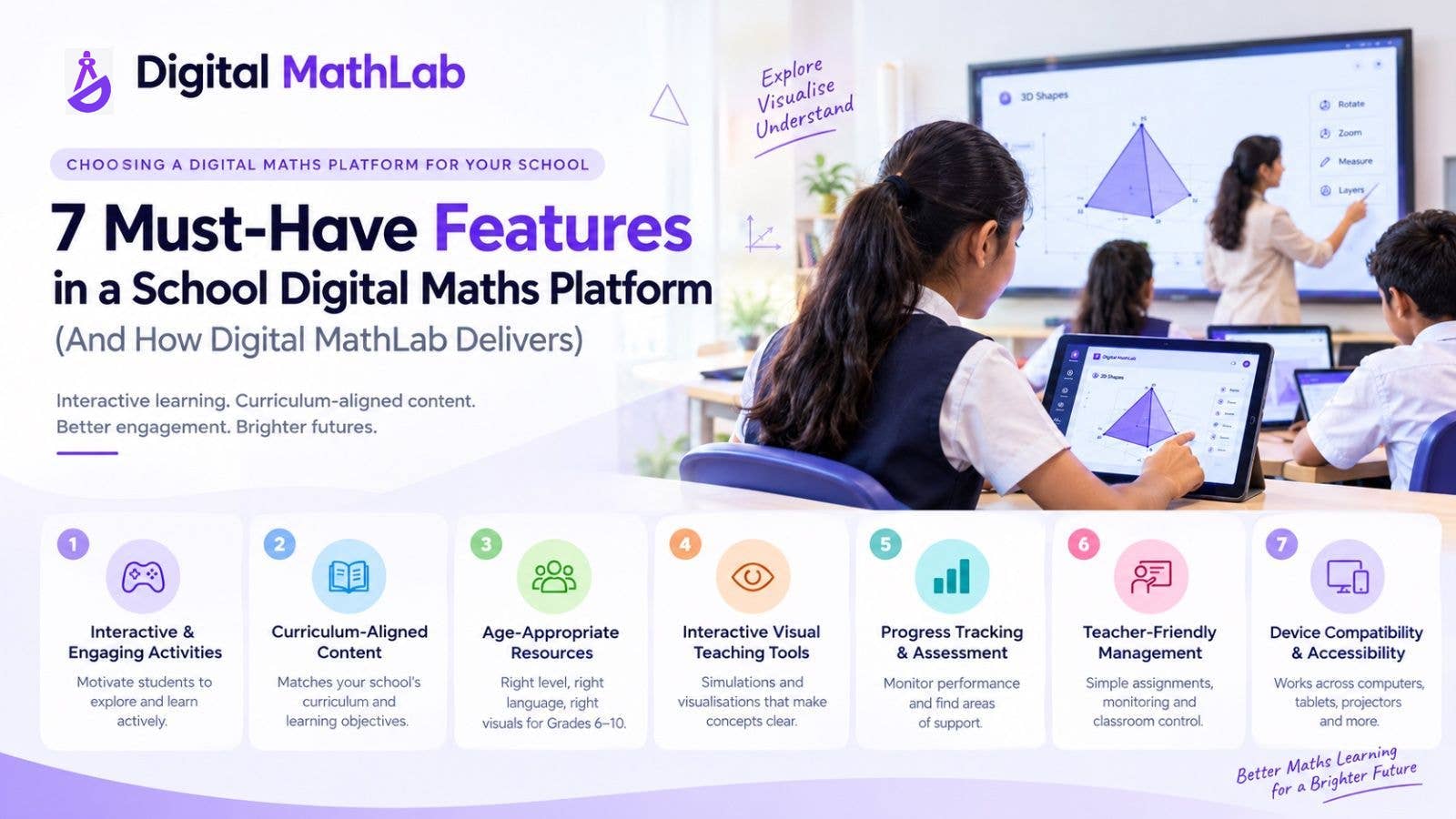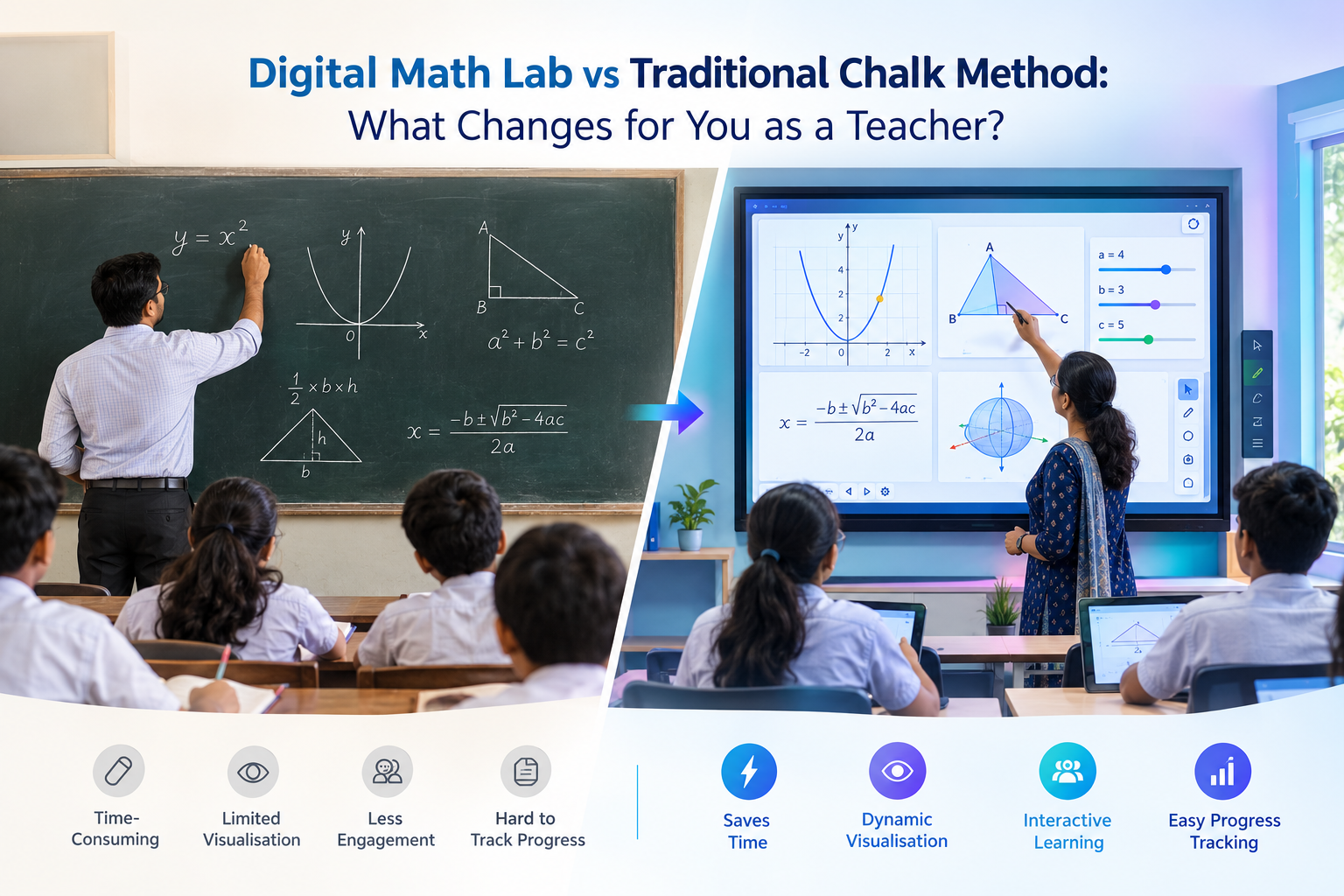
Mathematics education has relied on the traditional chalk and board method to teach students with written explanations and manual diagrams for centuries. Though it has persisted over time, modern classrooms require structured visual clarity and enhanced institutional efficiency for effective teaching.
Through the seamless integration of Digital MathLab, educators are now offered a formalized, technology-based resource to gradually transform from theoretical lectures to visual math teaching.
This formal overview examines the structural and operational changes that educators encounter when incorporating digital platforms into middle and secondary mathematics curricula.
Supporting NCERT Maths Teachers Managing Classes 6–10
Delivering effective mathematics education necessitates an adaptive resource that is capable of fitting into the official academic framework while being flexible for different teachers and instructional environments simultaneously. Digital MathLab is a mathematics platform designed exclusively for educators and institutions that complements the education of NCERT Mathematics for classes 6-10.
The software is designed for a wide range of educational providers.
- NCERT and CBSE school teachers
- Private and home tutors
- Tuition teachers and established coaching centres
- Online mathematics tutors
- Digital learning academies
Institutions managing middle-school academic programs
Notably, educators are not required to change their methodology since the software serves as a reliable digital CBSE maths helper for teachers, which works in tandem with the existing lesson plans to ensure the systematic reinforcement of standard NCERT learning objectives.
From Chalk-and-Board Lessons to Interactive Mathematics Teaching
Traditional static board explanations can struggle to convey complex multi-dimensional ideas and cannot perfectly capture the intended meaning. With interactive mathematics teaching activities, educators can show students abstract concepts with greater precision and repeat the demonstrations until clarity is achieved.
- Geometry: Instantly change or modify properties, avoid inaccuracies associated with manual drawing and see angles and shapes change in real time
- Algebra: See real-time visual representations of variables and equation balancing in action.
- Graphs: Plot coordinates and functions with speed and accuracy to demonstrate coordinate geometry
- Patterns: Clearly demonstrate numerical patterns and structural progressions to prove a mathematical rule.
Interactive mathematics uses visual models and hands-on experiences effectively, enabling students to grasp concepts, deepen understanding, and meet NCERT curriculum standards.
How Digital Tools Change Student Engagement and Concept Understanding
Students learn to process analytical problem-solving differently when structured digital tools are incorporated into instructional delivery. Guided digital exercises, simulations, and visual demonstrations enhance the quality of the process, which in turn galvanizes students to engage directly with mathematical concepts and principles.
An advantage that stands out is how this methodology supports experiential mathematics learning, where students can observe the immediate outcomes of mathematical operations.
Leveraging optimized maths learning software like Digital MathLab enhances the quality of learning and visualization teaching, ingraining foundational concepts and essential principles in students across multiple class sessions.
The software also replaces ambiguous manual illustrations with precise digital models that seamlessly operate as an instructional asset complementing professional teacher expertise.
Conclusion
Digital Math Lab, once integrated into daily instructional routines, streamlines lesson delivery, enhances classroom clarity, and supports diverse learning requirements while significantly revamping the fundamentals of classroom teaching. Technology at present serves to enhance and elevate a professional teacher’s skillset and expertise rather than replacing traditional instruction.
Empower your Class 6–10 NCERT curriculum with Digital MathLab. We invite educators, academic institutions, and premier tutoring providers to evaluate how our interactive, NCERT-aligned mathematics ecosystem elevates the teaching framework.