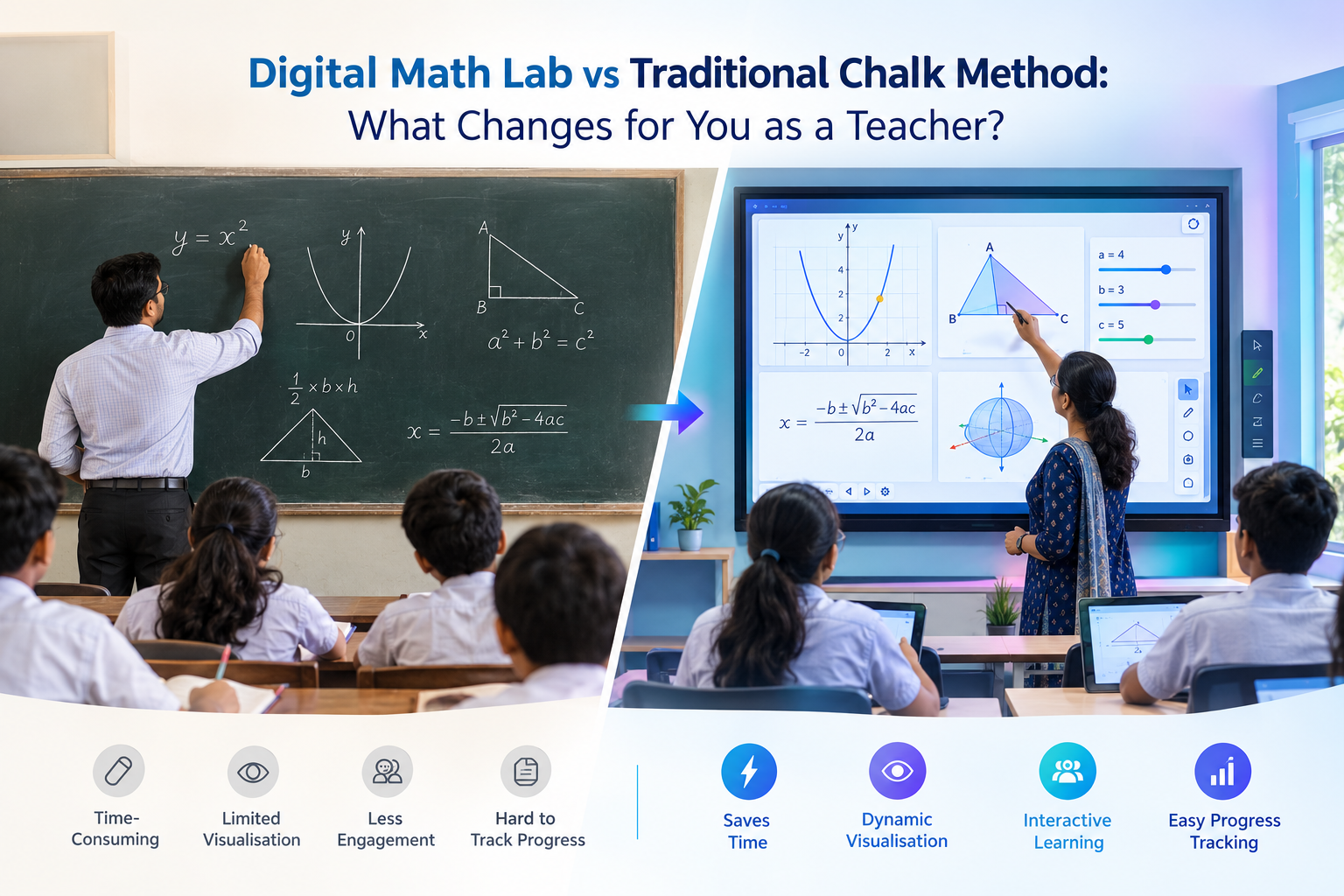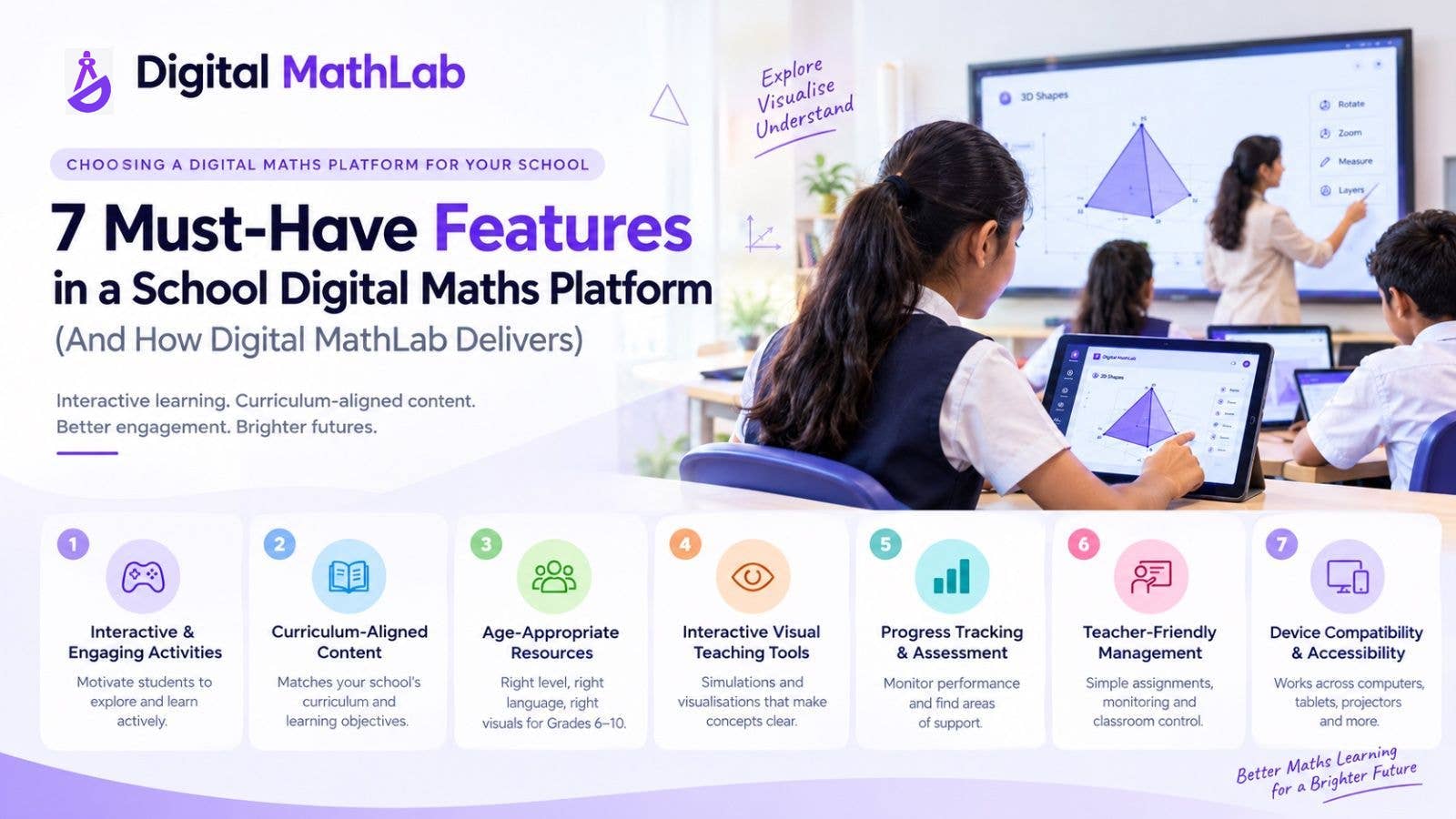
Before technological advancements revolutionised teaching, mathematics teachers used to spend long hours preparing learning materials, selecting examples, designing classroom activities, and creating assessments. Balancing lesson preparation with classroom teaching and student support can be time-intensive and demanding for teachers. Digital tools can support the teaching process by providing access to relevant learning resources, visual explanations, and interactive activities that teachers can incorporate into their lesson preparation.
Optimised interactive digital maths learning tools like Digital MathLab serve as supporting teaching resources that assist teachers in managing lesson preparation more easily while fulfilling curriculum requirements.
Why NCERT-Aligned Lesson Planning Matters for Mathematics Teachers
The NCERT curriculum provides a framework for teaching mathematical concepts progressively, focusing on learning objectives, conceptual understanding, and visualisations through appropriate classroom activities. Aligning lessons with this framework helps teachers organise instruction around defined learning outcomes.
Effective lesson planning mainly connects four essential elements:
- Learning objectives: Teachers can now identify and map out areas that students need to focus on or must put more effort into.
- Mathematical concepts: Break down complex math topics into manageable, logically comprehensible ideas.
- Classroom activities: Leverage visual examples, exercises, and interactive tasks to help students understand better and reinforce their fundamentals.
- Assessments: Review student performance and comprehension through questions, practice problems, and other suitable activities.
Structured math teaching tools like Digital MathLab enhance the quality of lesson preparation and review while placing conceptual understanding at the centre of classroom instruction.
From Traditional Lesson Preparation to Digital Math Lesson Planning
Traditional mathematics lesson planning used to rely heavily on textbook study, note preparation, example selection, worksheet design, and assessment creation, all of which are generally handled separately. Since teachers had to prepare multiple lessons across different classes, completing even one task could become increasingly time-consuming, placing excessive burden on them.
Digital MathLab helps mitigate these issues by offering an organised and optimised teaching platform to streamline lesson preparation and organise lesson content within a single digital workflow. Instead of creating content repeatedly, teachers can reuse the tool's supporting resources and adapt them to their teaching objectives.
These resources can complement traditional lesson preparation by offering additional ways to explain mathematical concepts and organise classroom activities. Teachers remain responsible for selecting appropriate materials, setting learning objectives, and preparing assessments.
How Teachers Can Build NCERT-Aligned Lessons in 15 Minutes
Digital MathLab supports this process through a structured planning approach.
Utilising structured digital resources can enable teachers to prepare a lesson outline in 15 minutes when relevant materials are easily accessible and the topic is familiar.
Digital MathLab is a supporting resource that assists teachers in this endeavour through a structured planning approach:
Select the NCERT Topic
- Start by selecting the class, chapter, and mathematical concept that you intend to teach.
- Identify the particular portion of the syllabus that you’re planning to cover in the lesson to retain consistency and keep the lesson focused on the topic.
Establish Learning Objectives
- Set clear goals by determining what you want your students to learn by the end of the session.
- For instance, if the lesson is on basic geometry, you could set the objective as ‘identifying different types of shapes’ or ‘distinguishing between 2D and 3D shapes’.
Organise Activities and Examples
- Choose relevant explanations, examples, practice questions, and interactive activities.
- With the help of digital lesson-planning resources, teachers can organise these examples and activities in an optimal sequence to instruct students with clarity.
Plan Learning Assessments
- Include questions, tasks, and exercises to assess whether students have understood the concept.
- Teachers can create short assessments that effectively gauge how well students understand the topic and identify areas requiring additional guidance.
Review and Adapt the Lesson
- Ensure that the lessons and syllabus align with the NCERT learning objectives, suit the students' learning levels, and are feasible within the designated class time.
- Teachers can also make necessary adjustments to their lesson plan before the session to ensure they do not miss out on any concepts.
These steps provide teachers with a practical framework for organising their lesson outlines while retaining control over their instructional decisions.
How Digital MathLab Supports Teachers Beyond Lesson Planning
Digital MathLab encourages mathematics teachers to teach beyond the initial preparation stage by helping them effectively plan their resources and put interactive learning experiences into practice.
Supporting Interactive Mathematics Learning
- Mathematical concepts become engaging and simpler when students learn with visual explanations, examples, and interactive activities.
- Digital learning resources complement textbook instruction, allowing teachers to approach the most complex and abstract concepts in different ways.
Reusing Digital Resources
- Reusable resources reduce the need for repeated preparation of the same materials.
- Teachers can now revisit suitable activities, modify examples and present them in new ways, and most importantly, adapt lesson structures according to different classes or learning objectives.
Monitoring Student Understanding
- Teachers can utilize planned practice questions and assessments to identify whether students have understood key concepts and if they require further assistance.
- Teachers can use assessment results and classroom observations to identify learning gaps and adjust their teaching approach accordingly.
Encouraging Engaging Math Education
- Digital tools might not be able to replicate classroom interaction, but they can effectively complement classroom discussions, problem-solving exercises, and individual practice.
- When used effectively, they can be highly useful for incorporating different types of teaching methods whilst retaining conceptual understanding at the core of mathematical learning.
Conclusion
The key elements of effective mathematics teaching include clear curriculum objectives, well-developed concepts, engaged students, and assessed progress. Digital MathLab is an educational tool that helps teachers prepare lessons more effectively by organising essential mathematical information and resources.
Digital MathLab helps teachers to plan NCERT-aligned lessons with better structure and flexibility. The effectiveness of digital resources depends on how teachers select and incorporate them into their preparation and classroom instruction. Relevant visualisations and interactive activities can provide additional ways to explain concepts and support student understanding. By doing so, the tool enables teachers to concentrate on lesson delivery and other aspects of teaching.
Explore Digital MathLab to discover how structured digital resources can streamline lesson preparation and help promote interactive teaching that is aligned with the curriculum.