How to Improve a Maths Lesson Plan Based on Student Performance
An effective math lesson plan is one that can evolve in alignment with students’ comprehension and learning levels. Students in NCERT classrooms generally grasp concepts at different paces. While some students can learn the lessons at a normal pace, others might struggle with fundamental concepts, making it difficult for them to apply mathematical formulas accurately or solve problems effectively.
But with a student-centric and data-driven learning approach, teachers can effectively mitigate these issues and help students grasp the subject with more clarity and retain it in their memory better. In this blog, we’ll explore how to calibrate maths lesson plans based on student performance.
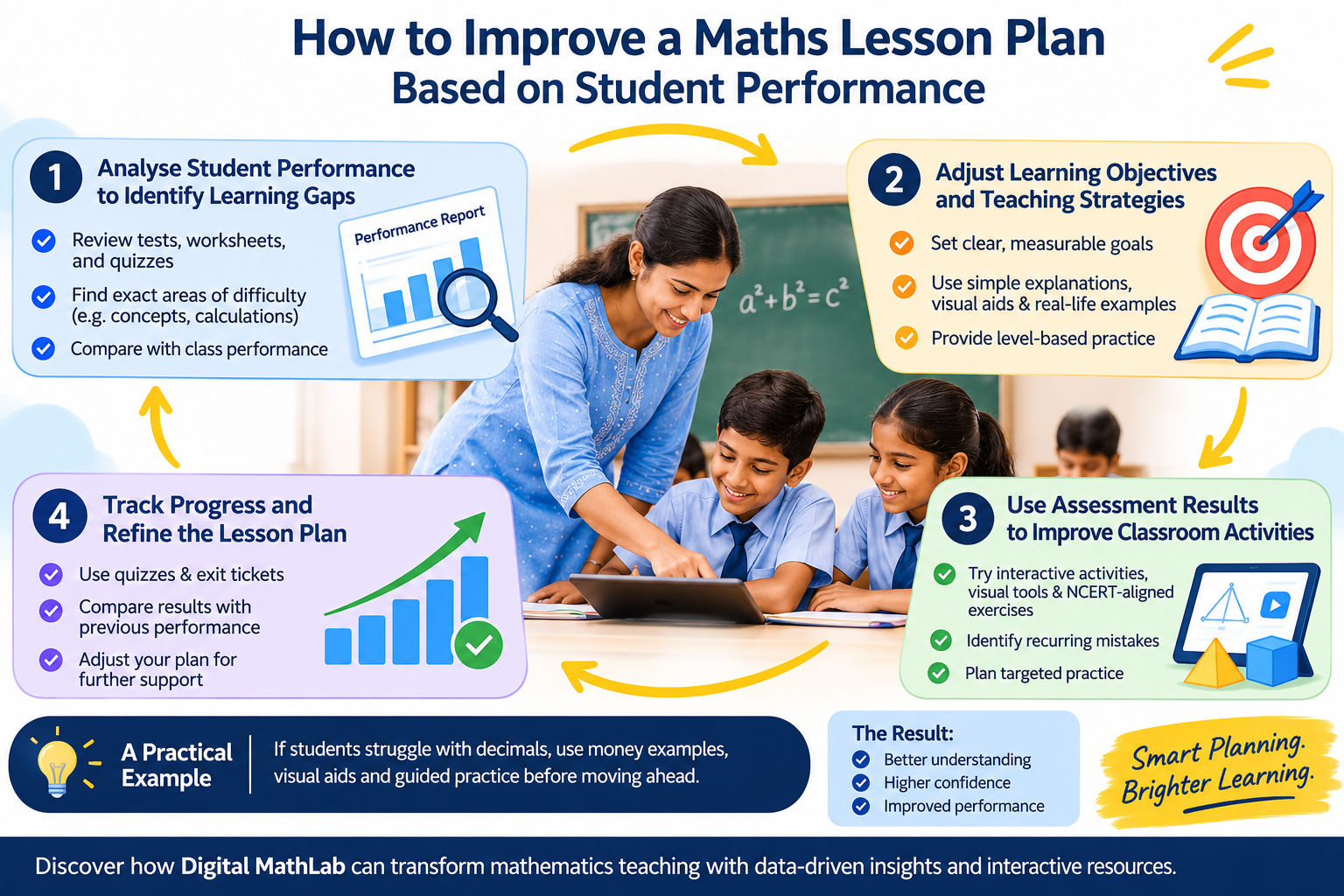
1. Analyse Student Performance to Identify Learning Gaps
- Evaluate available reports of a student's performance by analyzing their class tests, worksheets, homework, quizzes, and formative assessments rather than limiting the review to final marks alone.
- Identify areas where students have understood a concept without issues and map out those areas where they are struggling due to recurring errors.
- Recognizing the exact type of difficulty is also important, because a student might understand a concept well enough but make calculation errors, misapply a formula, or misunderstand the underlying idea. Compare individual progress with overall class performance to determine whether the gap is noticeable across the class or limited to few students only.
Conducting student performance analysis in mathematics gives teachers an idea whether a specific topic deserves targeted practice or reteaching before the class moves to the next NCERT chapter. It also helps teachers recognize that not all incorrect answers generally form from the same learning difficulty.
2. Adjust Learning Objectives and Teaching Strategies
- Once learning gaps are clear, set realistic and measurable objectives for the next lesson. Before moving to the next stage of an advanced concept, confirm whether students have understood the prerequisite concept. This is essential in keeping math lesson planning strategies connected to students’ progress.
- Each level of difficulty must be approached differently. Visual explanations, worked examples, real-life applications, and guided practice can help simplify even the most challenging ideas.
- Provide students with activities that match their level of understanding. Those who need guidance can work their way through simpler examples, whereas learners who have already mastered the basics can advance to more challenging questions.
For example, if Class 6 students struggle with decimals, use money examples to explain place values and decimal addition before moving on to more complex problems. This helps students understand the concept through everyday situations.
3. Use Assessment Results to Improve Classroom Activities
- Assessment must be detailed and thorough. It should necessarily inform the planning of the next lesson, not just record the previous performance. Utilize interactive demonstrations, targeted worksheets, and group problem-solving to identify potential weak points in the learning process.
- Opt for NCERT Maths teaching methods that encourage conceptual development. Try using visual aids such as diagrams or number lines to help students understand fractions if they are getting confused. Virtual visualizers and interactive math resources can simplify the explanation of abstract concepts such as shapes, sizes, and patterns.
These formative assessments provide teachers with timely feedback, helping them adapt lessons and help students understand the correct approach to solving problems.
4. Track Progress and Refine the Lesson Plan
- Once you’ve completed teaching the revised lessons, evaluate their efficacy. Use exit tickets, short quizzes, and follow-up assessments to check whether students are capable of applying concepts independently and measure the success rate of these changes. Compare results with previous performances and note which errors have reduced and which still need attention.
- Keep a proper record of frequently occurring mistakes, student engagement, and topics that require more assistance from the teacher. Based on these insights, modify your original study plan and make appropriate changes. Such adaptive learning processes make data-driven lesson planning a regular classroom practice, improving student performance and teaching quality.
- Schools and tuition centre owners can review assessment reports for their whole class/batch of students. These records can reveal common learning gaps and areas where extra support is required, allowing teachers to work together to plan follow-up lessons.
5. A Practical Example of Performance-Based Lesson Planning
Suppose a student has underperformed in a test on basic algebraic expressions. Instead of teaching the whole chapter once more, the teacher can:
- Pinpoint the exact area where the problem lies (variables, coefficients, simplification).
- Based on these findings, teach the students where they need guidance, help them understand foundational concepts, and most importantly, revise those concepts at the end.
- Use visuals, presentations, and guided NCERT-aligned exercises.
- Once the revision is complete, conduct a brief assessment to find out their current understanding.
- Use the results to decide whether the student is qualified to move forward or if they need additional assistance.
This method can be used in both schools and tuition centres. The teacher can go through each student’s response, and the proprietor can see trends across the batches and plan extra help.
Conclusion
Developing an effective math lesson plan means understanding what a student needs to learn and how to apply math concepts effectively. This is a gradual but ongoing process involving performance analysis, recognizing learning gaps, teaching calibration, reassessments, and continuous refinement. Making this cycle part of NCERT mathematics teaching helps ensure lesson objectives and classroom activities stay relevant to students’ progress.
Digital MathLab brings together NCERT-aligned interactive and engaging learning resources and assessment features capable of delivering seamless lesson delivery to students and providing deep insights into their performance.
Discover how Digital MathLab can transform mathematics teaching by integrating responsive practice and detailed assessments in your daily teaching practice.