How to Use Visual Learning to Explain Difficult Maths Concepts
Mathematics has been one of the most feared and misunderstood subjects for generations, with people reducing the subject to a rigid set of rules and formula memorization. Yet, under all that complexity lies something special, a universe of distinct patterns, logic, and puzzles that requires creative problem-solving and deep thinking. For generations, teaching math involved traditional textbooks, which relied on static text and two-dimensional diagrams to explain complex ideas - most of which would exit at the same speed they entered a student’s ear.
But as times change, the modern NCERT maths teaching methods are also evolving and shifting away from rote memorization, gradually moving towards experiential and visual frameworks. Platforms like Digital MathLab exist to serve this one purpose, incorporating the power of visualization in teaching with interactive maths learning resources to make teaching fun and engaging.
Why NCERT Maths Teaching Needs More Visual and Interactive Approaches
Teaching mathematics solely with textbook explanations and blackboard lectures leads to students relying excessively on formula memorization rather than comprehending the underlying principles intrinsically.
For instance, memorizing a formula could help a student answer how to calculate the area of a circle with a few numbers and a formula, but if you ask them how the formula was derived and why it works, they may struggle. This is the problem with understanding only the surface of a formula without delving into its origins.
Traditional classrooms also have different pacing and learning curves. The lecture might be informative but difficult to engage with because of its single-paced nature. This causes students to lag behind and lose interest in the subject. To address this issue, educational institutions have integrated visual and interactive approaches into their current teaching methods.
The biggest advantage of incorporating digital maths teaching tools into everyday classes is their ability to accommodate multiple learning styles simultaneously, ensuring every student has properly understood the essential core of the subject before they move on to complex problem-solving.
Use Visualization Tools to Explain Difficult Maths Concepts
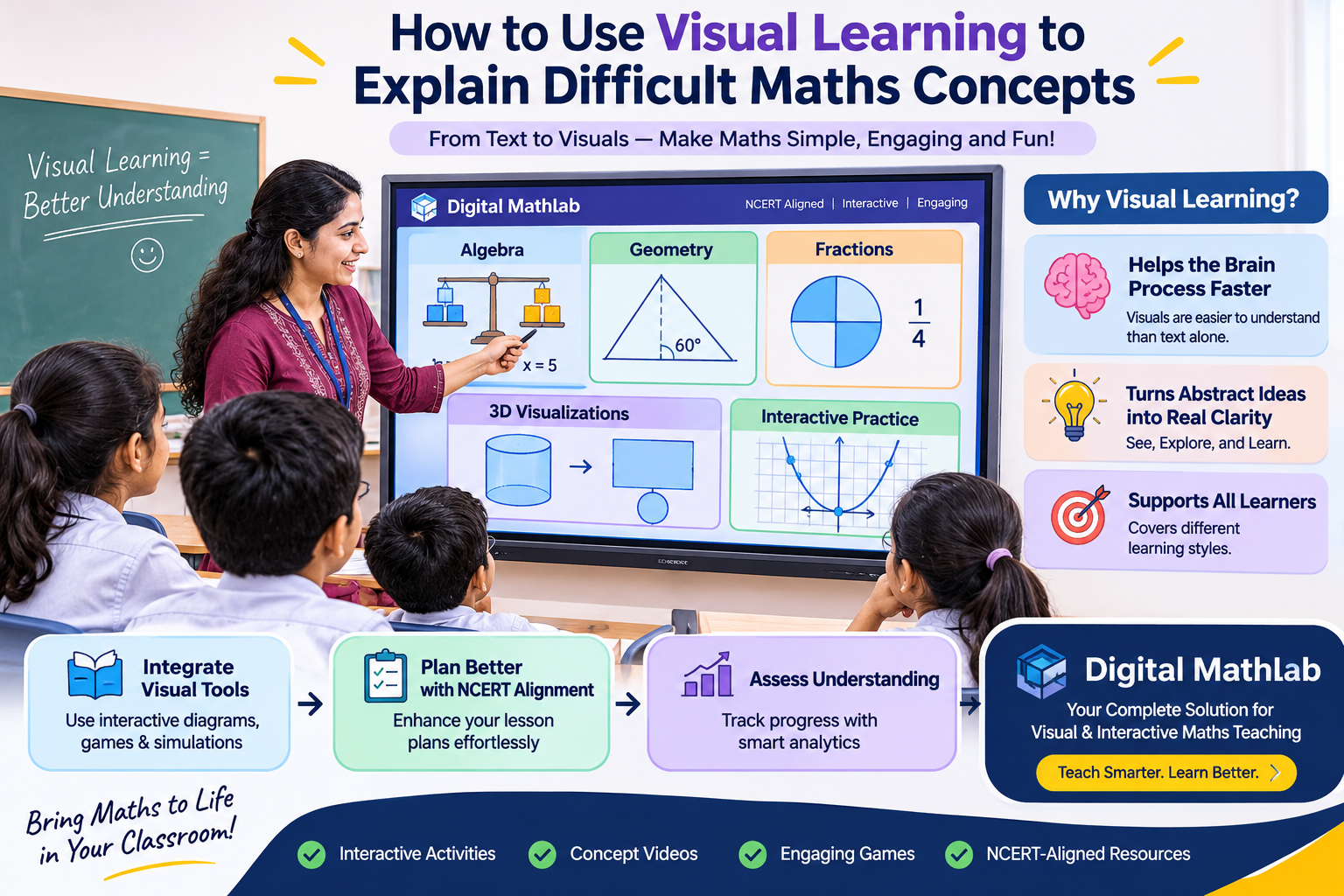
According to psychology, the human brain processes visual information more quickly than text. Visualization tools are the easiest way in which teachers can demonstrate abstract mathematics ideas, concepts, and topics through dynamic diagrams, interactive models, graphs, and digital experiments. In simple words, instead of imagining how the theorem works, students can actually see how it works in real time.
Consider how visual learning transforms standard NCERT topics across grade levels:
Algebra: Variables and algebraic expressions can be visualized by using balance scales and colored tile models. This helps to show students that an equation represents a balance between two sides.
Geometry: Students can interactively observe and explore parallel lines, alternate angles, and properties of polygons with less difficulty.
Fractions: Visual models and interactive number lines break down fractions into relatable parts, making addition, subtraction, and comparison intuitive.
3D Visualizations: Surface area and volume are shown easily by allowing students to open up a 3D cylinder or cone and explore how their nets are made up of 2D shapes.
Establishing strong visual clarity enables students to move from conceptual understanding to working on examples given in the textbook on their own. Digital MathLab provides ready-to-use visual teaching resources and interactive experiments that they can use in the classroom for every chapter without time-consuming preparation.
Make Classroom Teaching Interactive with Digital Maths Teaching Tools
A shift from the usual 2D textbook illustrations requires versatile classroom tools that can build curiosity in students effectively. Modern educators have revised and revamped lessons with step-by-step visual demonstrations, brain teaser puzzles, interactive experiments, educational games, and short concept videos.
Tuition centers that handle multiple batches can benefit from digital resources to make sure all lessons are taught with care and explanations are delivered with quality, precision, and consistency - ensuring students remain engaged throughout.
Digital MathLab offers multiple comprehensive collections of interactive activities, puzzles, games, and concept videos that bring mathematics to life, creating an environment that makes students genuinely interested in math and encourages them to look forward to problem-solving.
Integrate Visual Learning into Your NCERT Maths Lesson Plans
Successful implementation of visual learning does not necessarily mean the replacement of your curriculum; rather, it means the enrichment of your teaching resources. Educators can align visual demonstrations with individual chapters of the NCERT syllabus while ensuring that particular modules align with your daily learning goals.
Classroom teachers should include short digital visualizations in regular lesson plans as introductory tools before getting into textbook exercises. Meanwhile, tuition proprietors must create a set of visual teaching resources so that teaching quality remains consistent across different classes or batches and student retention is improved.
Digital MathLab provides educators with structured, high-quality, and fully functional mathematics resources that can be easily integrated into an established academic calendar, saving preparation time and optimizing instructional impact.
Assess Student Understanding After Visual Maths Lessons
Visual teaching is capable of naturally sparking curiosity and increasing discussions, but confirming whether the taught topic has been understood is equally important. Teachers must have apt methods to identify subject areas that require deeper explanations and those topics the students are ready for.
To effectively monitor student progress and achievements, schools and tuition centers should combine visual teaching with targeted formative assessments. Digital MathLab simplifies this process by offering intelligent assessment items, interactive learning materials, and comprehensive teacher analytics. These insights allow teachers to tailor their teaching approach, ensure timely corrective interventions, and make sure no students fall behind in their preparation for their main exams.
Conclusion
A combination of well-designed, NCERT-aligned teaching approaches and visual learning methods makes it easier for teachers to create a strong foundation for mathematical success. By leveraging visualization tools for mathematics, teachers can simplify complex mathematical concepts and formulas to make them easily understandable.
Platforms like Digital MathLab empower schools, teachers, and tuition centers with rich interactive teaching resources and intelligent assessments designed for modern classrooms. Explore the platform today and experience how seamless digital integration can transform your mathematics curriculum.